The Rise of AI-Powered Phishing: How to Spot the New Threats
Phishing attacks have been a persistent threat since the earliest days of the internet, but the landscape has changed dramatically. Where once a poorly spelled email from a supposed Nigerian prince was the hallmark of a scam, today's AI-powered phishing campaigns are virtually indistinguishable from legitimate communications. According to the European Union Agency for Cybersecurity (ENISA), AI-enhanced phishing attacks increased by over 135% across EU member states in 2025, and the trend is accelerating into 2026.
For European citizens and businesses alike, understanding these new threats is no longer optional. The EU's updated Network and Information Security Directive (NIS2), which took full effect in October 2024, places explicit obligations on organizations to train employees against social engineering attacks. But compliance starts with awareness, and awareness starts with understanding exactly how these attacks work.
How AI Has Transformed Phishing
Traditional phishing relied on volume: send millions of generic emails and hope a small percentage clicks. The grammar was often poor, the branding sloppy, and the sender addresses obviously fake. AI has changed every aspect of this equation.
Hyper-Personalized Emails
Large language models (LLMs) can now scrape publicly available information from LinkedIn, company websites, social media, and data breach repositories to craft emails that reference specific projects, colleagues, and internal terminology. A finance manager at a German manufacturing firm might receive an email that references an actual supplier, uses correct invoice formatting, and mentions a real purchase order number obtained from a previous data leak.
These are not theoretical scenarios. In March 2025, Europol reported dismantling a criminal network operating out of Eastern Europe that used AI to generate over 40,000 targeted phishing emails per day, each customized with personal details harvested from social media and dark web databases. The group had successfully compromised 1,200 European businesses before being caught.
Deepfake Voice Phishing (Vishing)
Perhaps the most alarming development is the rise of deepfake voice calls. With as little as three seconds of audio, modern AI tools can clone a person's voice with startling accuracy. Criminals are using this technology to impersonate CEOs, CFOs, and other executives in what security researchers call "voice phishing" or "vishing" attacks.
In a documented case from September 2025, a Dutch logistics company transferred EUR 243,000 after a finance director received a phone call from someone who sounded exactly like the CEO, urgently requesting a transfer to a "new supplier." The voice was an AI clone generated from earnings call recordings available on YouTube.
Real-Time Chat Manipulation
AI chatbots are now deployed on fake customer service portals and social media accounts to engage victims in real-time conversations. Unlike scripted bots of the past, these systems can handle unexpected questions, maintain consistent personas, and adapt their social engineering tactics based on the victim's responses. They can convincingly impersonate bank representatives, government officials, or tech support agents for extended conversations.
The Red Flags: How to Spot AI-Powered Phishing
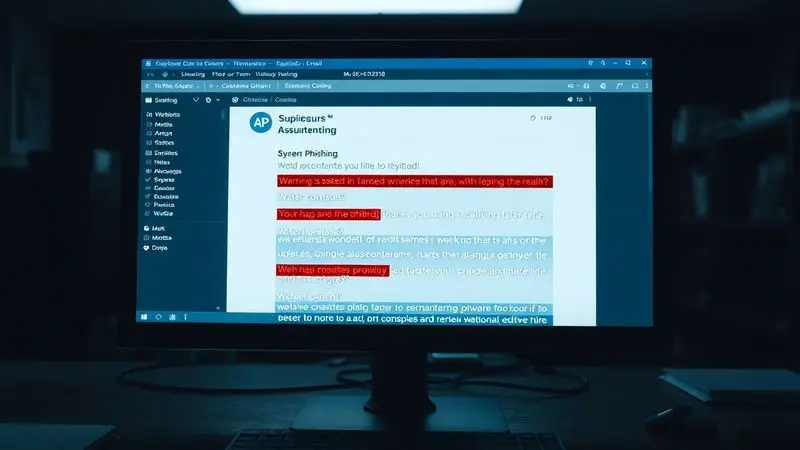
While AI has made phishing harder to detect, it has not made it impossible. Here are the key indicators that can help you identify even sophisticated attacks:
1. Urgency and Emotional Pressure
AI-crafted messages are specifically designed to trigger emotional responses that bypass rational thinking. Watch for language that creates artificial urgency: "Your account will be suspended in 2 hours," "Immediate action required to avoid legal proceedings," or "Confidential - do not discuss with colleagues." Legitimate organizations, especially within the EU where GDPR protections apply, rarely demand immediate action under threat.
2. Unusual Communication Channels
If your CEO has never sent you a WhatsApp message asking you to purchase gift cards, that first time should set off alarm bells. AI phishing often exploits the gap between different communication platforms. A request that comes through an unusual channel, particularly one that bypasses corporate email security filters, should be treated with extreme suspicion.
3. Verify the Sender Domain Carefully
AI-generated emails often use domains that are visually similar to legitimate ones. Common tricks include substituting characters (using "rn" to mimic "m"), adding hyphens (company-support.com vs. companysupport.com), or using alternative top-level domains (.eu vs .com). Always hover over email addresses and links to verify the actual URL before clicking.
4. Too-Perfect Writing
Ironically, one tell-tale sign of AI-generated phishing is writing that is too polished. If a colleague who typically writes casual, typo-laden emails suddenly sends a perfectly structured, formal message, that inconsistency itself is a warning sign. AI models tend to produce consistently high-quality prose that may not match the sender's typical communication style.
5. Requests to Bypass Normal Procedures
Any communication that asks you to circumvent established security protocols, whether it is skipping two-factor authentication, sending credentials via a non-standard method, or processing a payment outside the normal approval chain, should be treated as suspicious regardless of who appears to have sent it.
EU Reporting Mechanisms and Legal Framework
The European Union has established several reporting pathways for phishing attacks, and it is crucial that victims report incidents promptly. Under the NIS2 Directive (Directive (EU) 2022/2555), organizations classified as "essential" or "important" entities are legally required to report significant cyber incidents within 24 hours of becoming aware of them, with a detailed follow-up within 72 hours.
- National CSIRTs: Each EU member state operates a Computer Security Incident Response Team. Report phishing attacks to your country's CSIRT. In Germany, contact BSI (Federal Office for Information Security). In France, report to ANSSI. The Netherlands uses the NCSC.
- Europol's EC3: The European Cybercrime Centre coordinates cross-border investigations. For large-scale or international phishing campaigns, report through your national police's cybercrime unit, which escalates to Europol as needed.
- ENISA Threat Reporting: The EU Agency for Cybersecurity collects threat intelligence that helps shape continent-wide defense strategies. Report emerging phishing techniques through their incident reporting portal.
- National Data Protection Authorities: If a phishing attack results in a personal data breach, GDPR Article 33 requires notification to your national Data Protection Authority within 72 hours. Affected individuals must also be notified under Article 34 if the breach poses high risk to their rights.
Corporate Training: Building a Human Firewall
Technology alone cannot stop AI-powered phishing. The most effective defense is a well-trained workforce. Under the NIS2 Directive and various national implementations, organizations are required to provide regular cybersecurity awareness training. Here is what effective training programs should include:
Regular phishing simulations: At least quarterly, organizations should run simulated phishing exercises using the latest AI-generated techniques. These should not be punitive but educational, with immediate feedback when employees click on simulated phishing links. Studies by ENISA show that organizations conducting monthly simulations reduce successful phishing by 75% within one year.
Multi-channel awareness: Training should cover not just email phishing but also vishing (voice), smishing (SMS), and social media-based attacks. With the rise of deepfake voice technology, employees handling financial transactions should be trained to use callback verification through independently verified phone numbers.
Incident response drills: Every employee should know exactly what to do when they suspect a phishing attempt: who to contact, how to preserve evidence, and what not to do (such as forwarding the suspicious message to colleagues, which can spread malware if attachments are involved).
Role-based training: Finance teams, executives, and IT administrators face different threats and need tailored training. A CFO needs to understand CEO fraud scenarios, while an IT administrator needs to recognize credential harvesting attempts targeting admin portals.
Technical Defenses Against AI Phishing
While human awareness is the first line of defense, technical measures remain essential. Organizations operating in the EU should implement the following:
- DMARC, DKIM, and SPF: These email authentication protocols verify that messages actually come from the domains they claim to originate from. The EU's recommendation is to enforce DMARC with a "reject" policy, which prevents spoofed emails from reaching inboxes at all.
- AI-powered email filtering: Fight AI with AI. Modern email security solutions use machine learning to analyze writing patterns, sender behavior, and link destinations to flag suspicious messages before they reach users.
- Multi-factor authentication (MFA): Even if credentials are compromised through phishing, MFA provides a second barrier. Hardware security keys (FIDO2/WebAuthn) are the strongest option, as they are resistant to phishing by design.
- Zero-trust architecture: Moving to a zero-trust model, where every access request is verified regardless of network location, limits the damage from successful phishing by restricting what compromised credentials can access.
- Browser isolation: Enterprise browser isolation technology renders web content in a secure cloud environment, ensuring that even if an employee clicks a malicious link, the malware cannot reach their device.
Real-World AI Phishing Attacks in Europe
Understanding real attack patterns helps individuals and organizations recognize threats. Here are documented cases from recent years:
The "EU Grant" Campaign (2025): A sophisticated campaign targeted small and medium-sized enterprises across the EU with emails purportedly from the European Commission about new grant funding. The AI-generated emails used correct EU formatting, referenced real Horizon Europe programs, and directed recipients to pixel-perfect replicas of the EC login portal. Over 3,000 businesses had credentials stolen before the campaign was identified.
Deepfake Board Meeting (2025): In one of the most audacious attacks on record, a Finnish technology company held what it believed was a video conference with three board members. Two of the three video feeds were deepfakes generated in real time. The attackers authorized a EUR 1.2 million transfer during the meeting. This case prompted ENISA to issue specific guidance on verifying participant identity in virtual meetings.
The Tax Season Surge (2025): Every January through April, phishing campaigns impersonating national tax authorities surge across Europe. In 2025, AI-generated versions were nearly flawless, using correct taxpayer identification numbers (likely sourced from previous breaches) and directing to fake portals that replicated national tax filing systems pixel for pixel. The attacks hit France, Germany, Spain, and Italy simultaneously.
Personal Protection: Steps Every European Should Take
You do not need to be an IT professional to protect yourself against AI-powered phishing. Here are practical steps anyone can implement:
- Enable MFA everywhere: Turn on two-factor authentication for all online accounts, particularly email, banking, and social media. Use an authenticator app rather than SMS where possible.
- Establish family code words: Create a secret verification word or phrase that family members can use to confirm identity in unexpected phone calls. This defeats deepfake voice cloning.
- Verify independently: If you receive an unexpected request, especially one involving money or credentials, verify it through a separate communication channel. If your "bank" emails you, call the number printed on your card, not the number in the email.
- Keep software updated: Ensure your operating system, browser, and email client are always running the latest versions. Security patches frequently address vulnerabilities that phishing attacks exploit.
- Use a password manager: Password managers will not auto-fill credentials on fake websites, providing an additional layer of protection against credential-harvesting phishing pages.
- Check for HTTPS and certificate details: While HTTPS alone does not guarantee a site is legitimate, its absence is a definite red flag. Check the certificate details for unexpected issuing authorities.
Looking Ahead: The AI Arms Race in Cybersecurity
The battle between AI-powered attacks and AI-powered defenses will define cybersecurity in the years ahead. The European Commission's AI Act (Regulation (EU) 2024/1689), which entered into force in August 2024, classifies AI systems used for social engineering and manipulation as "unacceptable risk," meaning their deployment is prohibited within the EU. However, enforcement against criminal actors operating from outside EU borders remains a significant challenge.
ENISA's 2026 threat landscape report predicts that AI-generated phishing will become so convincing that traditional awareness training alone will be insufficient. The agency recommends a layered approach: combining human awareness with AI-powered detection systems, strict authentication protocols, and organizational processes that make it structurally difficult for a single compromised individual to cause significant damage.
The most important takeaway is this: in an era of AI-powered social engineering, trust but verify. Every unexpected communication, no matter how convincing it appears, deserves a moment of critical evaluation before action. That pause, that moment of healthy skepticism, remains the single most effective defense against even the most sophisticated AI-powered phishing attack.


Stay Informed
Get the latest safety insights delivered to your inbox.